|

NASDAQ spikes 10% after Trump pauses tariffs for 90 days

  • Trump pauses so-called "reciprocal" tariffs for 90 days.
  • NASDAQ Composite explodes 10% higher as Trump pauses severe bilateral tariffs.
  • Trump administration keeps 10% worldwide tariff in place.
  • S&P 500 and Dow Jones also spike above 7%.
In one the most volatile sessions in living memory, the NASDAQ Composite spiked as much as 10% on Wednesday after US President Trump surprised everyone with a sudden 90-day pause on US tariffs. The tech-heavy index shot up as much as 10% to 16,752 from an intraday low of 15,270.

Prior to the rally, the NASDAQ Composite had traded flat for part of the session. The Dow Jones Industrial Average (DJIA) and S&P 500 also spiked more than 7% on the news.

Trump halts US tariff policy for 90 days

In a certain sense, it would seem that the world beat Trump in round one of this trade war. US stock market indices sold off en masse in the three sessions following Trump's new tariff policy that was first announced last Wednesday. Wall Street denounced the policy broadly, and some of Trump's allies like Elon Musk disparaged his trade advisor Peter Navarro. It appears the gambit worked.

Trump relented on Wednesday after only a week. Under the new policy, the Trump administration will stick to its 10% broad-based tariff rate on all foreign imports but delay its much higher rates, such as 24% on Japan and 46% on Vietnam, for the time being.

However, Trump didn't budge on China, and instead, he announced a 125% tariff rate on Chinese goods due to that nation's response of announcing its own 34% additional tariff to US goods. The proposed base rate had been 104% on Chinese goods as of Tuesday, following several rounds of new tariffs.

On Wednesday morning, China announced that it would ditch its initial 34% added tariff rate on US goods and instead go with an 84% rate.
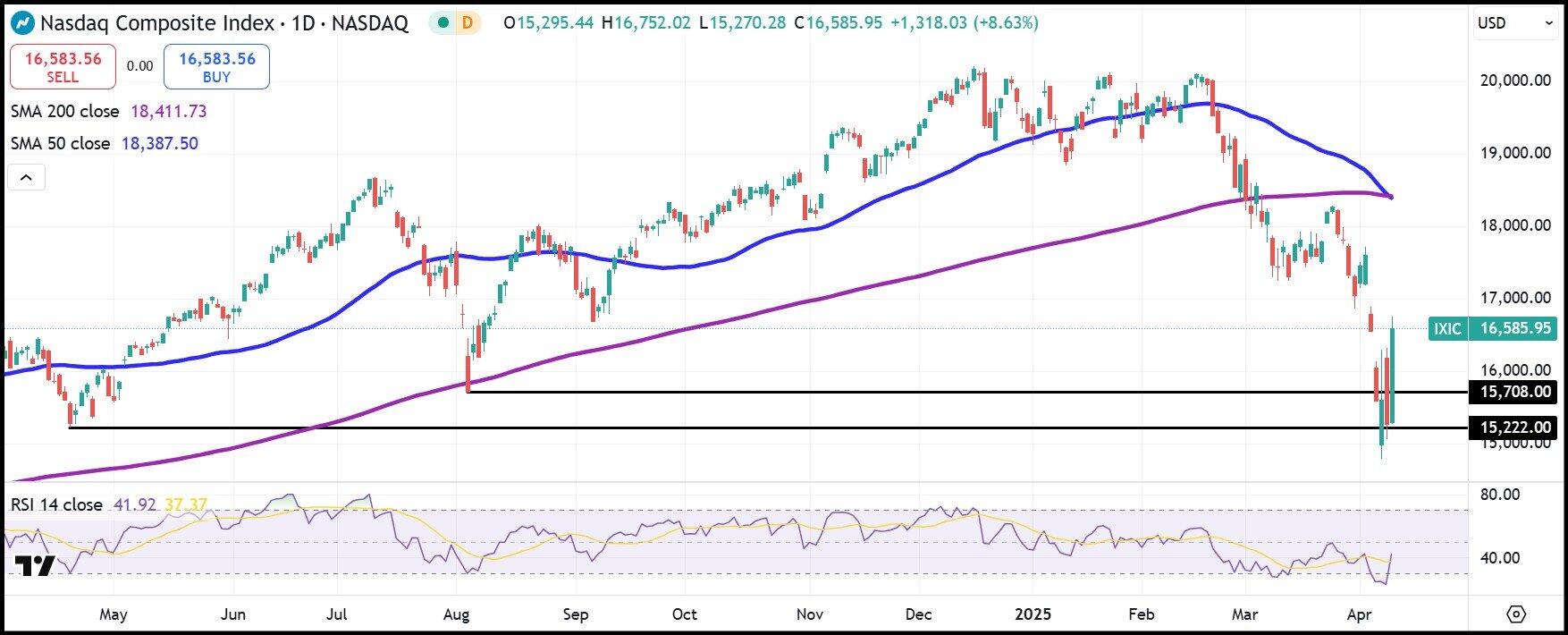
NASDAQ Composite daily index chart

NASDAQ Composite daily index chart

Author

Clay Webster

Clay Webster

FXStreet

Clay Webster grew up in the US outside Buffalo, New York and Lancaster, Pennsylvania. He began investing after college following the 2008 financial crisis.


More from Clay Webster
Share:

Editor's Picks

GBP/USD flirts with monthly lows around 1.3300

GBP/USD sets aside Friday’s uptick and retreats markedly toward the 1.3300 yardstcik on Monday. Falling crude oil prices following a pause in the Middle East conflict in combination with the recent soft reading in UK inflation appear to play against any BoE tightening ahead of the bank’s event later in the week.

EUR/USD fades the initial move above 1.1400

EUR/USD loses bullish momentum and slips back below the 1.1400 region at the beginning of the week. Hopes of a de-escalation in the Middle East appears to lend support to the pair, although uncertainty persists over whether the US and Iran can reach a lasting solution.

Gold trims early gains as Oil prices and US Dollar rebound, Fed decision looms
Gold (XAU/USD) opens the week with a bullish gap on Monday but struggles to build on its early advance as optimism over a temporary pause in attacks between the United States (US) and Iran fades and Oil prices recover from intraday lows. At the time of writing, XAU/USD trades around $4,083 after briefly climbing above $4,100, up 0.77% on the day.
Bitcoin holds above key support amid ETF inflows, US-Iran bombing pause
Bitcoin (BTC) holds above the key 200-week Simple Moving Average (SMA) around $63,500, having posted four consecutive weeks of gains. Institutional demand shows mild signs of improvement with spot Exchange Traded Funds (ETFs) posting inflows for a third consecutive week.
Bitcoin options traders are dropping their hedges going into the Fed meeting
Bitcoin's options market has turned notably less defensive over the past month, unwinding the downside protection traders built up in June just as the Federal Reserve prepares to meet.
US Dollar mid-year outlook: Exceptional currency, exceptional risks?
The US Dollar enters the second half of 2026 in a markedly different position from a year ago. The King currency has recovered, reflecting persistent US inflation, changing expectations for Fed policy, geopolitical tensions and renewed demand for defensive assets.